
From the Mould to the Finished Block
Table of Contents
So, we’ve made our foam, mixed it with the cement slurry and filled the moulds. Now comes the part where you discover whether all that messing about has actually produced something useful.
Fortunately, aircrete is remarkably forgiving.
Let it set
Once the mould has been filled, leave it alone.
This sounds obvious, but it is worth saying because there is a temptation to keep poking at it, smoothing it, prodding it or otherwise interfering with it.
Don’t.
The mixture will initially look much too soft to become a useful building material. It is largely cement paste surrounding a huge number of tiny air bubbles, and it needs time to develop its strength.
How long it takes depends on the temperature, the particular cement and the size of the mould, but don’t expect to take a block out of the mould after an hour and start building with it.
For small moulds, I normally leave the material until it has become firm enough to handle without deforming. Larger moulds may need considerably longer.
Getting it out of the mould
This is where the design of the mould becomes important.
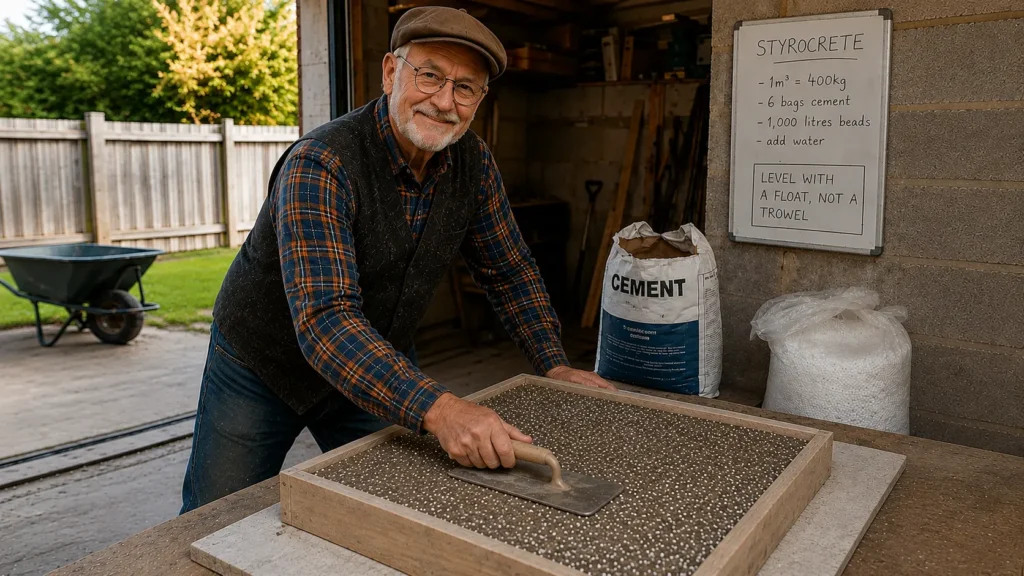
You don’t need an elaborate commercial mould. In fact, one of the advantages of making aircrete yourself is that you can make moulds to whatever size and shape you actually need.
The important thing is that the mould allows the newly formed block to come out without having to fight it.
A mould that can be dismantled or has removable sides makes life considerably easier.
When the aircrete has set sufficiently, remove the sides carefully and lift the block out.
Don’t be surprised if the surface isn’t perfectly smooth. Aircrete isn’t intended to look like polished concrete. The surface will normally show the characteristic fine cellular structure produced by the foam.
And that cellular structure is precisely what we wanted.
Don’t confuse “set” with “cured”
There is an important difference here.
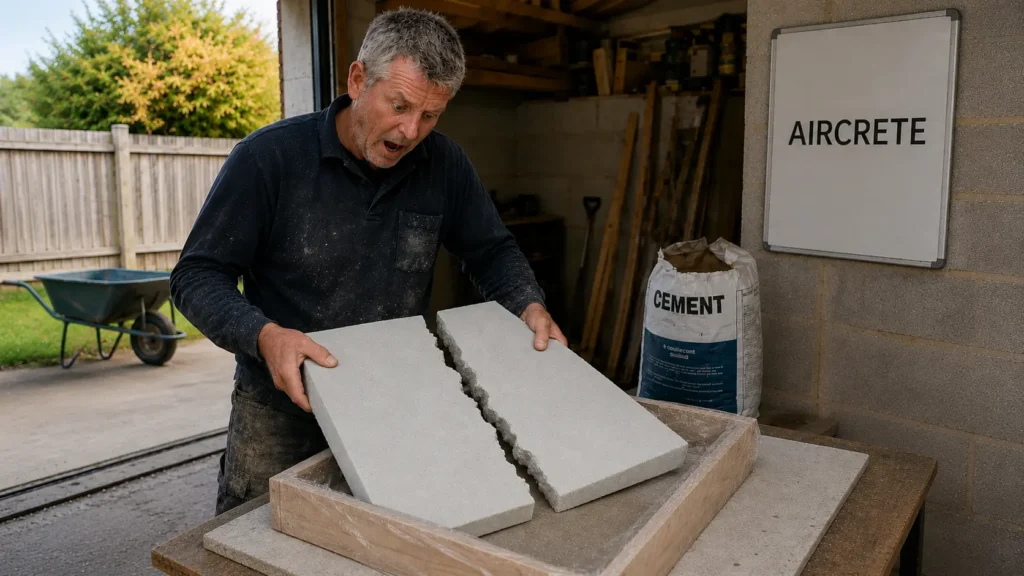
When the block becomes hard enough to remove from the mould, it has set. That doesn’t mean that it has reached its final strength.
Cement continues to hydrate and gain strength for a considerable time after it has become hard.
So although the freshly demoulded block may look like a finished building block, treat it with a little respect. It is still relatively young.
I prefer to give the blocks plenty of time before asking them to do any serious work.
The lighter the block, the more air you’ve put into it
One of the interesting things about aircrete is that you can alter its characteristics by changing the amount and quality of foam.
More stable foam means more air in the finished material and therefore a lighter block.
Less foam means a denser material with more cement and less air.
This is why foam density matters so much. We’re not simply trying to make as much froth as possible and throw it into the cement. We want a stable, fine foam that survives the mixing process and leaves millions of small air cells throughout the finished material.
That is also why I keep emphasising gentle mixing.
If you attack the mixture with a drill paddle as though you’re mixing plaster, you’ll start destroying the very thing you’ve gone to all the trouble of making.
What you end up with
A properly made block is surprisingly light for its size.
Pick one up and the first reaction is often:
“That’s concrete?”
Well, sort of.
It contains Portland cement, but much of the volume that would normally be occupied by solid aggregate has been replaced by air.
The result is a material that can be cut, drilled and worked with ordinary tools much more easily than conventional concrete.
And that is really the attraction of making it yourself.
You’re not trying to reproduce a factory-made concrete block.
You’re making a lightweight cementitious material whose properties you can alter according to what you want to use it for.
And there is one more thing…
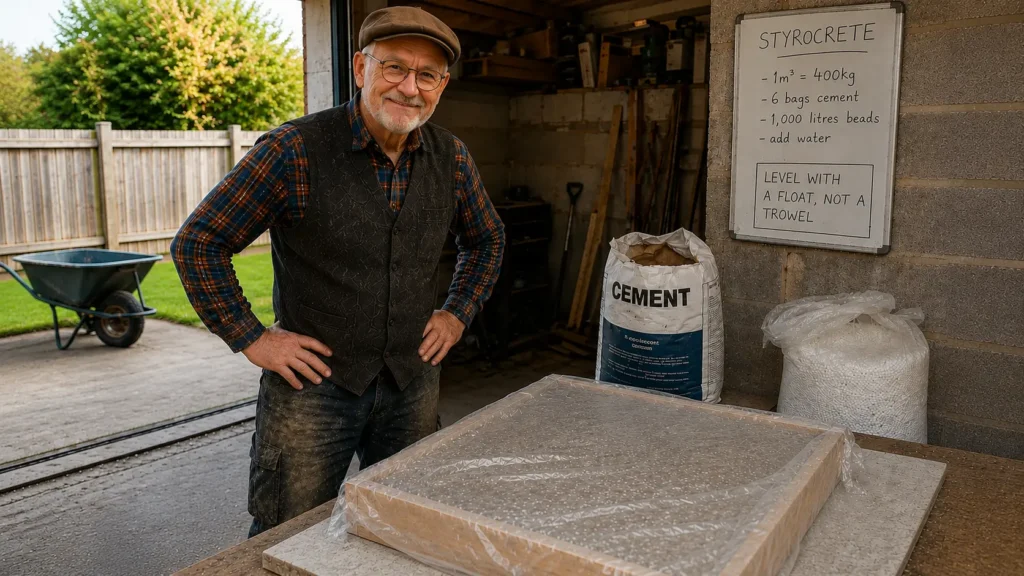
The first block you make probably won’t be perfect.
Mine weren’t.
You may get a slightly different density from one batch to the next. You may find that your foam generator produces foam that is too wet, or that you have put a little too much or too little foam into the mix.
That’s part of the process.
The useful thing about making your own aircrete is that once you’ve made a few batches, you begin to understand what the mixture should look and feel like.
And once you can recognise that, you’re no longer simply following a recipe.
You’re making aircrete.