
What is DIY Aircrete

Table of Contents
Concrete is heavy.
That’s one of the things we normally accept without thinking about it. Mix cement, sand, stone and water, and you end up with something that isn’t going anywhere in a hurry.
But what if we could make concrete with thousands of tiny air spaces throughout it?
We can.
It’s called aircrete, although you’ll also find it described as foamed concrete, foam concrete or cellular concrete.
And the basic idea is surprisingly simple.
Concrete with the stone taken out — and air put in
Ordinary concrete contains aggregate — usually sand and stone — which gives the finished material much of its weight and strength.
Aircrete takes a different approach.
Instead of filling the mixture with aggregate, we make a cement-based slurry and introduce a large quantity of stable foam into it.
The foam consists of countless small bubbles. When the material hardens, those bubbles leave behind a network of tiny air-filled cells.
The result is a solid material that can be dramatically lighter than ordinary concrete.
The American Concrete Institute describes cellular concrete as a cementitious material containing a homogeneous system of voids produced using gas-forming chemicals or foaming agents. In the preformed-foam process, the foam is made separately and then mixed into the cement slurry.
And that is essentially what we’re going to be making.
So why would you want concrete full of holes?
Because the holes are useful.
Aircrete can be made at different densities, and changing the amount of air changes the properties of the finished material.
Generally, as we put more air into the mix:
the density goes down
the weight goes down
the thermal insulation improves
but
the strength also goes down.
That’s the fundamental trade-off.
The engineering literature on cellular concrete specifically identifies density as one of the major factors controlling properties such as compressive strength and thermal conductivity.
So we’re not simply trying to make the lightest possible block.
We’re trying to find the point where the material has the properties we actually need.
And that’s where things start getting interesting.
Aircrete isn’t the same as aerated concrete blocks
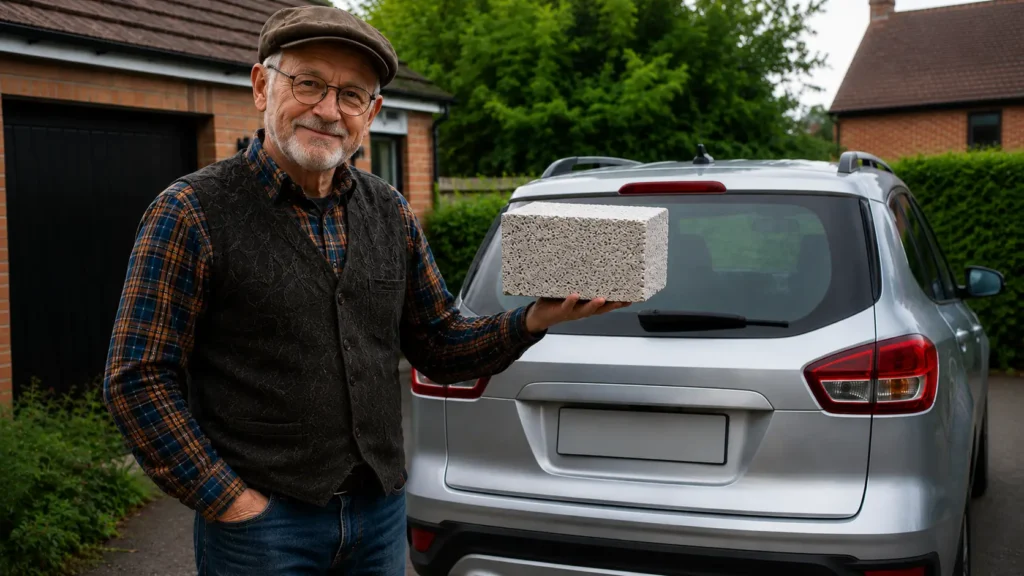
There is an important distinction here.
You may already have seen lightweight white building blocks sold as AAC — Autoclaved Aerated Concrete.
They are related to the same general idea: a cementitious material containing a huge number of air-filled pores.
But AAC is an industrial product manufactured under controlled conditions, including autoclaving.
That’s not what we’re making.
Our aircrete is foamed concrete made with preformed foam.
The foam is generated separately and then mixed into the cement slurry.
That makes it something that can actually be experimented with in a reasonably well-equipped DIY workshop.
And that’s exactly what we’re interested in here.
The really clever bit
Look at a normal piece of concrete.
It’s mostly solid material.
Now imagine taking some of that solid material away and replacing it with air.
You’re making the material lighter without making it disappear.
Do it on a sufficiently large scale and you can end up with a block that is surprisingly easy to handle.
The Federal Highway Administration describes foamed concrete as a lightweight, practically self-levelling material, with applications including lightweight fills and other construction uses.
That opens up some interesting possibilities for the DIY builder.
But there is a catch.
Light doesn’t automatically mean strong.
And this is where a lot of internet discussions about aircrete go wrong.
You will find claims that aircrete can be used for almost anything.
That’s not how materials engineering works.
A 300 kg/m³ material and an 800 kg/m³ material may both be called aircrete, but they are not going to behave the same way.
The amount and stability of the air voids, the cement content, water content, curing and the resulting density all matter.
That’s why, rather than simply copying somebody else’s recipe and declaring that it works, we’re going to make some and find out what we’ve actually produced.
What are we going to make?
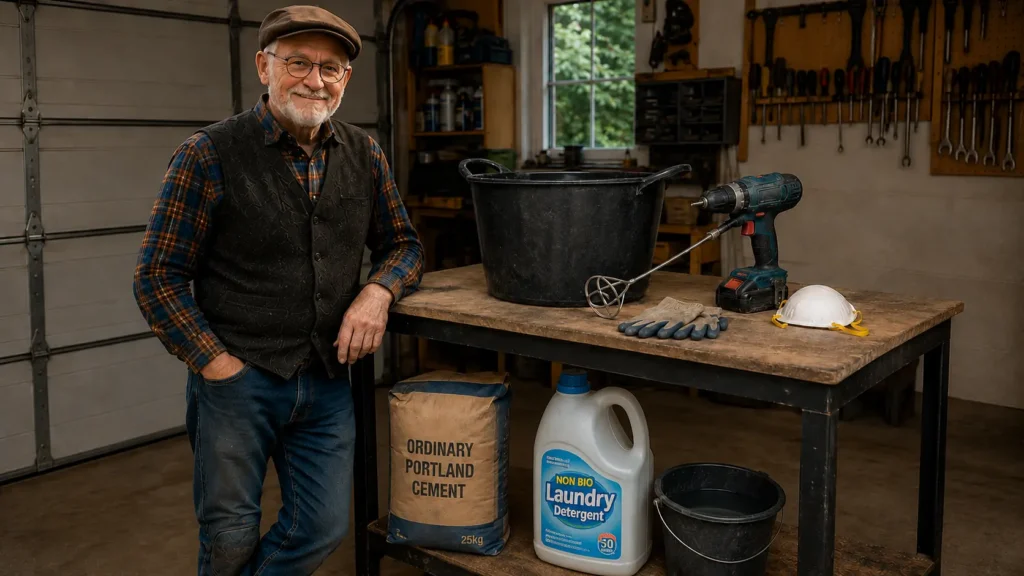
For this series we’re interested in the relatively simple DIY version:
cement + water + preformed foam
No conventional sand-and-stone aggregate.
The foam is the important ingredient.
It isn’t just ordinary air whipped into the mixture. We need bubbles that are stable enough to survive mixing and remain distributed throughout the cement paste.
That is why the equipment used to generate the foam matters.
And it is also why mixing aircrete isn’t quite the same as mixing ordinary concrete.
Too little foam and we’ve simply made lightweight cement.
Too much—or foam that isn’t stable enough—and we can end up with something that has plenty of air but not much useful material holding it together.
Getting the balance right is going to be the interesting part.
And that gives us an experiment
Rather than starting this series by telling you:
“Here’s the perfect aircrete recipe.”
I’d much rather do what we did with Styrocrete.
Let’s make it.
We’ll start with a small batch.
We’ll make some foam.
We’ll mix it into the cement.
We’ll put it into a mould.
And then we’ll wait.
Because when we take the mould apart, we’ll have something much more useful than a recipe.
We’ll have a piece of aircrete that we made ourselves.
Then we can weigh it, examine it, cut it, test it and see what happens when we change the proportions.
That’s when aircrete gets interesting.
A note about the terminology
Throughout this series I’m using “aircrete” as the convenient DIY name for foamed/cellular concrete made with preformed foam. It should not be confused with AAC (autoclaved aerated concrete), which is a different industrial manufacturing process.
And one other important point: the air-voids in aircrete are not the same thing as the small amount of microscopic air deliberately entrained into conventional concrete. Conventional air-entrainment is normally only a few percent of the concrete volume; foamed concrete deliberately introduces a much larger volume of stable foam.
Next: Chapter 2 — What Do We Need to Make Aircrete?
We’ll look at the cement, water, foaming agent, foam generator, mixer and moulds — and, importantly, what each one actually does.