
Styrocrete Is The Lightweight Concrete That Could Save You Time, Money and Hard Work
- Styrocrete Is The Lightweight Concrete That Could Save You Time, Money and Hard Work
- So… Why Would Anyone Want Lightweight Concrete?
- What Can I Use It For?
- Is It Heavy?
- Is It Strong?
- Is It A Good Insulator?
- Is It Waterproof?
Have you ever picked up a bag of concrete and wished it weighed a tenth as much?
Or looked at all the white polystyrene packaging from a new television or microwave and wondered whether it could be used for something useful instead of filling the wheelie bin?
If so, you may have just discovered Styrocrete.
Although it sounds like a specialist building material, the idea is surprisingly simple.
Styrocrete is made by mixing ordinary cement with expanded polystyrene (EPS). Instead of producing heavy concrete, the result is a lightweight material that provides excellent insulation while still being easy to shape and pour.
It’s not a replacement for structural concrete.
It’s a completely different material designed for different jobs.
So… Why Would Anyone Want Lightweight Concrete?
That’s the obvious question.
After all, isn’t concrete supposed to be heavy?
Sometimes.
But not always.
There are many jobs where weight is actually the enemy.
For example, imagine trying to fill an uneven floor that is 100 mm deep.
Using ordinary concrete could add hundreds of kilograms to the building.
Styrocrete does the same job while adding only a fraction of the weight.
What Can I Use It For?

This is where Styrocrete really starts to make sense.
It’s ideal for:
- Conservatory floors
- Garage floors
- Garden rooms
- Workshops
- Shed bases
- Filling deep voids
- Levelling uneven concrete
- Roof insulation
- Pipe trenches
- Underfloor heating installations
- Areas where insulation is just as important as strength
It’s particularly useful wherever you want to reduce heat loss through a concrete floor.
Is It Heavy?
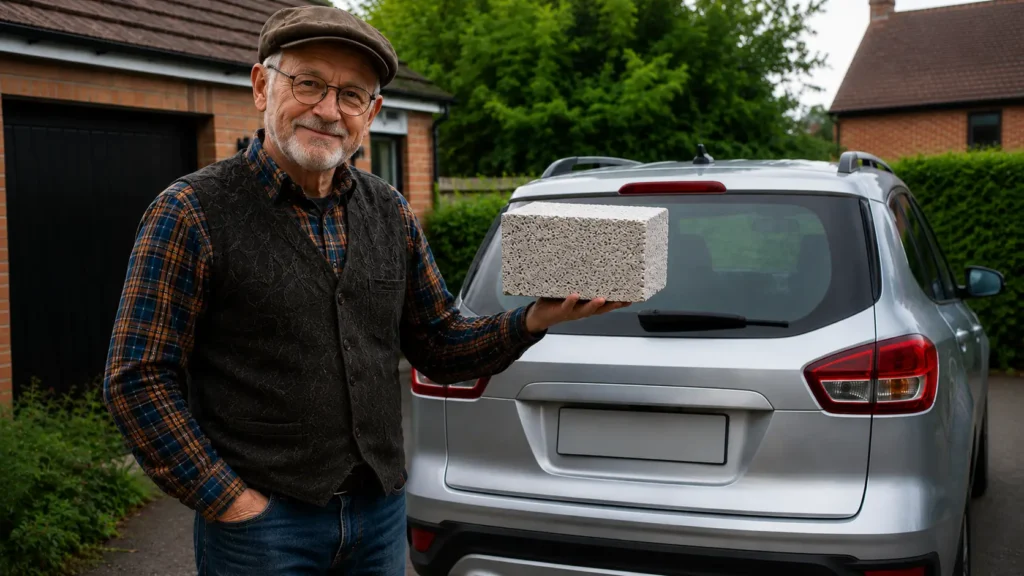
Quite the opposite.
This is one of its biggest advantages.
Depending on the mix, Styrocrete can weigh only a small fraction of ordinary concrete.
That makes it much easier to move, spread and work with.
Your back will probably appreciate it too.
Is It Strong?
This is probably the most common question.
The honest answer is…
strong enough for the jobs it was designed to do.
Styrocrete is not intended to replace structural concrete.
You wouldn’t build bridge supports from it.
But underneath a concrete screed, beneath floor insulation, or as a lightweight filling material, it performs extremely well.
Think of it as an insulating layer rather than a structural one.
Is It A Good Insulator?

Yes.
Very good.
That’s one of the reasons builders use it.
The millions of tiny pockets of air trapped inside the polystyrene reduce the flow of heat through the floor.
A warmer floor often means a warmer room.
It can also reduce heating costs over time.
Is It Waterproof?
Not completely. What Is Styrocrete?
The Lightweight Concrete That Could Save You Time, Money and Hard Work
Have you ever picked up a bag of concrete and wished it weighed a tenth as much?
Or looked at all the white polystyrene packaging from a new television or microwave and wondered whether it could be used for something useful instead of filling the wheelie bin?
If so, you may have just discovered Styrocrete.
Although it sounds like a specialist building material, the idea is surprisingly simple.
Styrocrete is made by mixing ordinary cement with expanded polystyrene (EPS). Instead of producing heavy concrete, the result is a lightweight material that provides excellent insulation while still being easy to shape and pour.
It’s not a replacement for structural concrete.
It’s a completely different material designed for different jobs.
If you can mix cement…
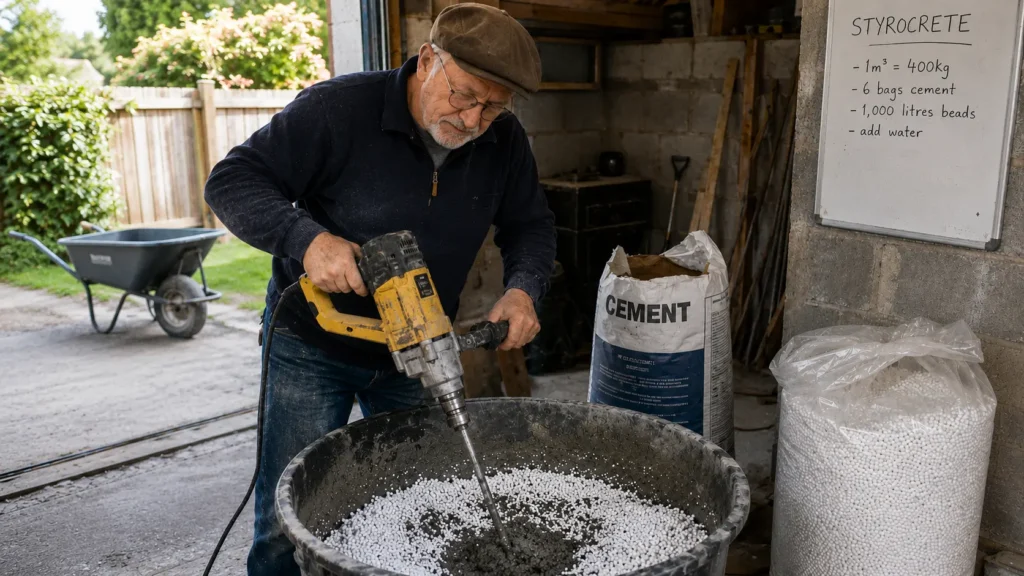
One of the nicest surprises is how little specialist equipment you actually need.
A strong mixing container.
A drill with a paddle mixer.
Some cement.
Some expanded polystyrene.
Water.
That’s about it.
Why Doesn’t Everybody Use It?
Because many people simply don’t know it exists.
Others assume it’s complicated.
Or expensive.
In reality, many DIY builders are surprised by how accessible it is.
Especially if the polystyrene is recycled from packaging that would otherwise be thrown away.
Is It Worth Trying?
If your project needs:
✔ lightweight filling
✔ insulation
✔ easier handling than ordinary concrete
then absolutely.
Start with a small test batch.
See how it behaves.
By the second mix you’ll probably wonder why you ever thought it sounded difficult.
Next Step
Now that you know what Styrocrete is, the obvious question becomes:
“Where do I get all that polystyrene without spending a fortune?”
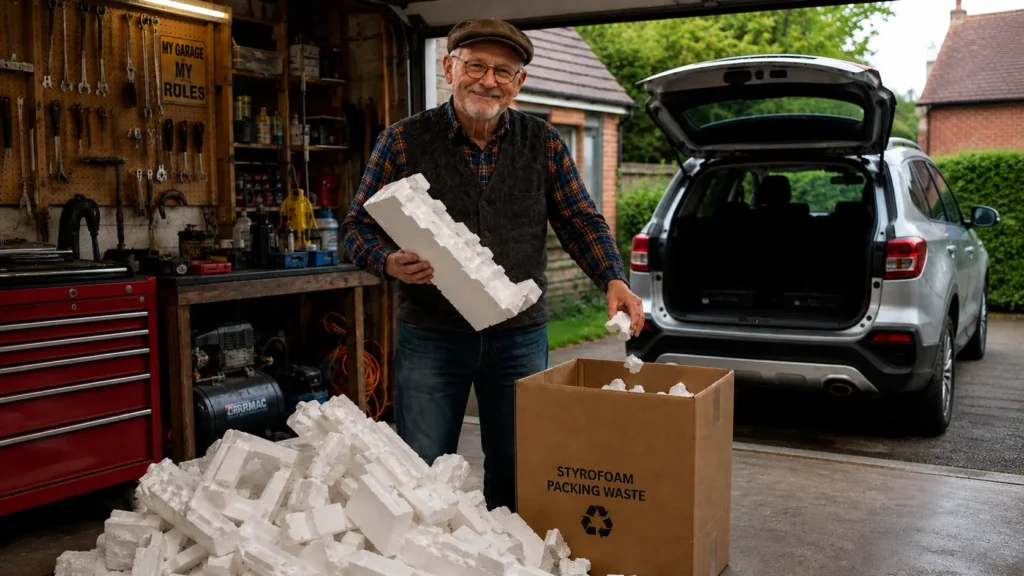
That’s exactly what we’ll cover in the next article.
Tom’s Workshop Tip
If you’re wondering whether Styrocrete is “too technical” for a DIY project, remember this: the difficult part isn’t mixing it—it’s discovering that it exists in the first place. Once you’ve seen it made, you’ll realise it’s simply another useful building material, and one that’s surprisingly forgiving for beginners.