
Got A Blockage John?
A blocked toilet is one of those household problems that nobody particularly wants to deal with.
The good news is that many toilet blockages are relatively simple to clear. The bad news is that if you keep flushing a blocked toilet, you can very quickly turn a minor blockage into a rather unpleasant flood.
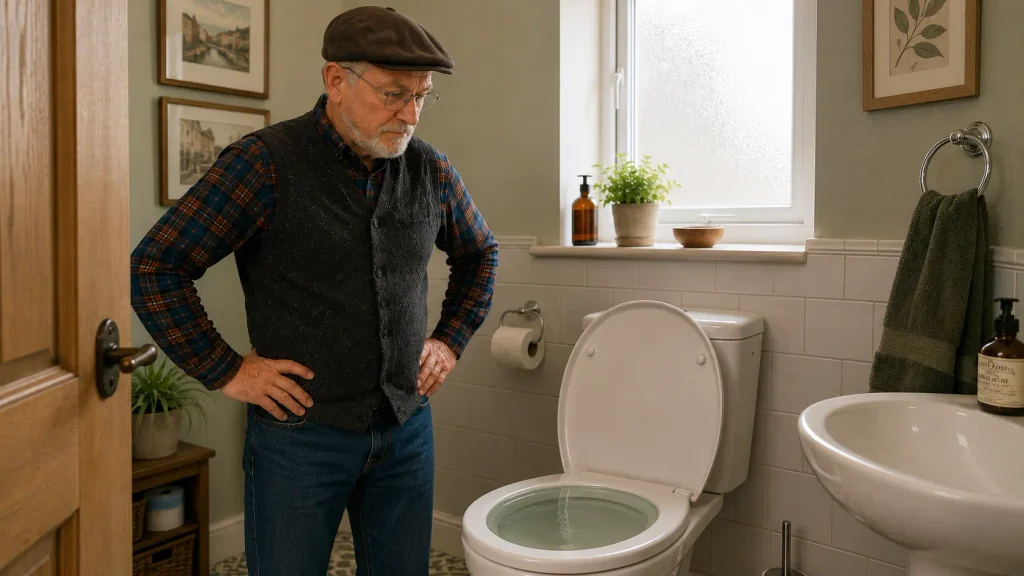
So the first rule is simple:
If the water isn’t going down, don’t flush again.
In this guide we’ll start with the simplest methods and work towards finding the blockage when it isn’t actually in the toilet itself.
Table of Contents
Stop the Toilet Overflowing First
If the bowl is already full, don’t flush it again.
If water is still entering the bowl, stop the supply to the toilet.
Most modern toilets have a small isolation valve on the pipe supplying the cistern. Turn the valve clockwise to shut off the water.
If there isn’t an isolation valve, remove the cistern lid and prevent the float from allowing the cistern to refill.
The important thing is to stop adding water to a blocked system.
Give the bowl a little time. If the water level slowly falls, you probably have a partial blockage. If it remains at the same level, you have a more substantial obstruction.
Where Is the Blockage?
Before reaching for a plunger, it is worth thinking about where the blockage actually is.
There are three likely places:
1. In the toilet itself
The obstruction may be in the toilet’s internal trap — the curved section designed to retain water and prevent sewer gases entering the house.
This is often caused by excessive toilet paper or something that shouldn’t have been flushed.
2. Immediately after the toilet
The toilet may be perfectly clear but the waste pipe leaving it may be blocked.
3. Further downstream
The blockage may be somewhere in a shared waste pipe serving the toilet and possibly other fixtures.
This distinction matters because you can spend all afternoon attacking the toilet when the bloody blockage isn’t in the toilet at all.
If the Toilet Trap Is Blocked
If the blockage is in the toilet itself, start with the simplest tool:
The Toilet Plunger
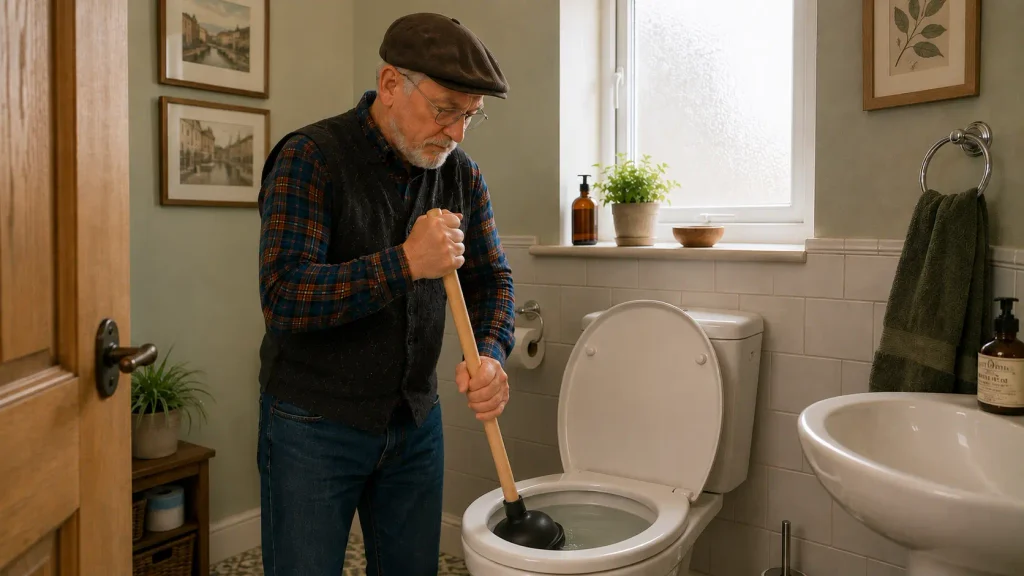
Use a toilet plunger with a flange rather than the flat-ended plunger normally used on a sink.
The flange fits into the toilet outlet and gives you a much better seal.
If there isn’t enough water in the bowl to cover the rubber part of the plunger, add a little water.
Place the plunger firmly over the outlet.
The first push should be gentle. You’re trying to remove the air from the plunger and establish a seal rather than immediately forcing half the contents of the toilet into the plumbing system.
Once you have a good seal, use a series of firm pushes and pulls.
The pulling action is particularly useful because it can draw the obstruction back towards the bowl rather than simply driving it farther down the pipe.
After several strokes, pause and see whether the water level begins to fall.
If it does, don’t immediately celebrate by flushing the toilet.
Add a small amount of water and make sure it drains properly first.
If the Plunger Doesn’t Work
The next step is a toilet auger, sometimes called a closet auger.
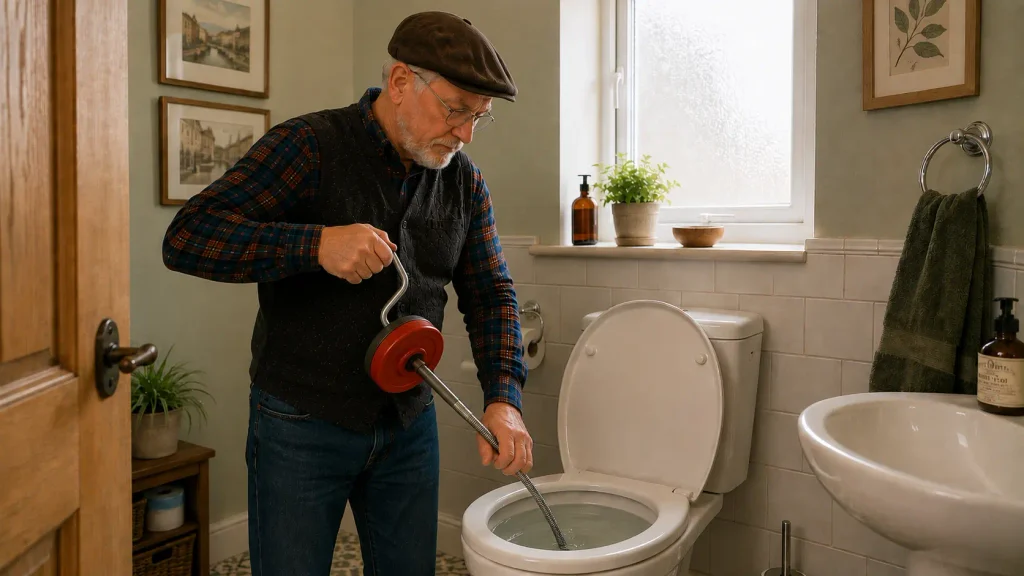
It is designed specifically for working through the trap of a toilet without scratching the porcelain or requiring the toilet to be removed.
Feed the end of the auger carefully into the outlet.
Turn the handle as you push it forward.
When you encounter resistance, rotate the auger and work it against the obstruction.
Depending on what has caused the blockage, the auger may:
- break the obstruction apart;
- push it through;
- or catch it so that it can be withdrawn.
Don’t use excessive force.
If you’ve dropped a solid object such as a child’s toy into the toilet, retrieving it is preferable to forcing it farther into the waste pipe.
What About Hot Water and Washing-Up Liquid?
You’ll find this suggested everywhere on the internet.
A little washing-up liquid followed by warm, not boiling, water may help with a soft blockage by lubricating the trap and loosening material.
It is worth trying if the blockage is minor.
But don’t treat it as a magic solution.
Never pour boiling water into a toilet.
The sudden temperature change can damage porcelain and potentially cause cracking.
When the Blockage Isn’t in the Toilet
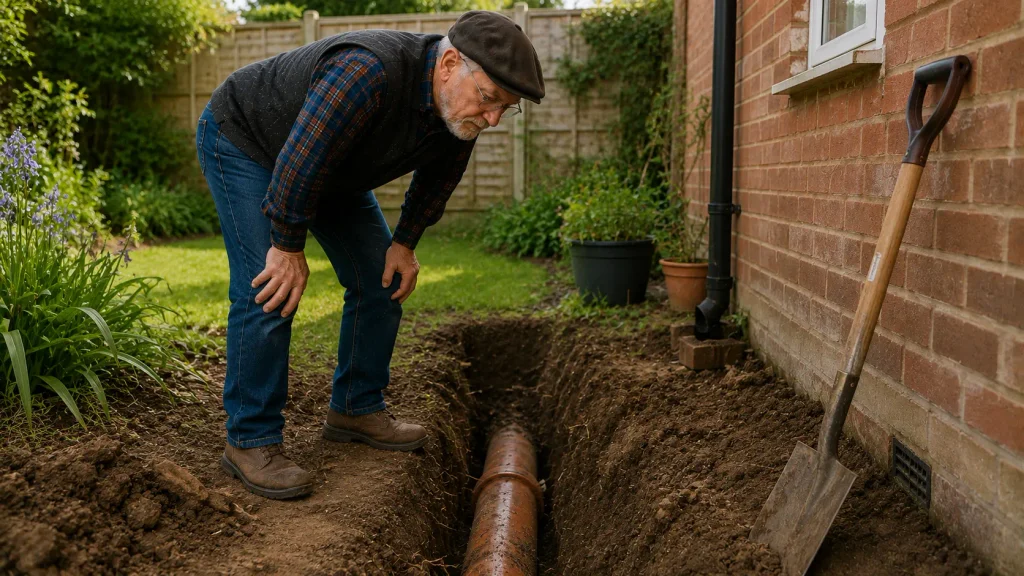
This is where things become more interesting.
Suppose you’ve tried the plunger and auger and the toilet remains blocked.
Or perhaps the toilet empties eventually, but then blocks again.
Before dismantling anything, look at the rest of the plumbing.
Ask yourself:
- Does the bath or shower drain normally?
- Does the bathroom sink drain normally?
- Are other toilets affected?
- Do you hear gurgling from another drain when the toilet is flushed?
- Does water rise somewhere else when the toilet is used?
These observations can tell you whether the problem is local to the toilet or further down the drainage system.
Finding a Downstream Blockage
This is where a simple principle can save a lot of unnecessary work:
Divide the system into sections and find out which section is blocked.
If you have accessible inspection points, drain covers or pipe joints, you can work progressively along the drainage route.
For example, imagine the waste pipe runs:
Toilet → inspection point → second inspection point → main drain
If the toilet is full but the first accessible section beyond it is clear, the blockage is further downstream.
If you have access to two points in the drainage system, you can effectively use a half-split approach:
- Choose an accessible point roughly halfway along the suspected run.
- Open it carefully.
- Determine which side contains the backed-up water or blockage.
- Concentrate your investigation on that half.
- Repeat if necessary.
Each test eliminates approximately half of the remaining pipe.
It is the same principle used when fault-finding electrical circuits, telephone cables or virtually any other system where you don’t know where the fault lies.
But be careful when opening drainage points.
A blocked pipe may contain a considerable quantity of unpleasant material under pressure.
Open inspection covers slowly and cautiously, standing to one side rather than directly over them.
If the pipe is badly backed up, this may be the point where calling a drainage professional becomes the sensible option.
What Not to Do
There are several tempting approaches that can make the situation worse.
Don’t keep flushing.
This is the easiest way to turn a blocked toilet into an overflowing toilet.
Don’t ram objects down it.
Coat hangers, sticks and improvised tools can damage the toilet trap or push an obstruction farther into the drainage system.
Don’t use excessive force with a plunger.
A good seal and controlled strokes are much more effective than trying to recreate a hydraulic ram.
Don’t blindly pour chemical drain cleaner into it.
Toilet blockages are not necessarily the sort of blockage that chemicals will dissolve, and caustic chemicals can create a serious hazard when you subsequently have to work on the plumbing.
When You Need More Than a Plunger
You may have moved beyond a simple toilet blockage if:
- the toilet repeatedly blocks after being cleared;
- several fixtures are affected;
- wastewater is backing up into another drain;
- you can hear persistent gurgling;
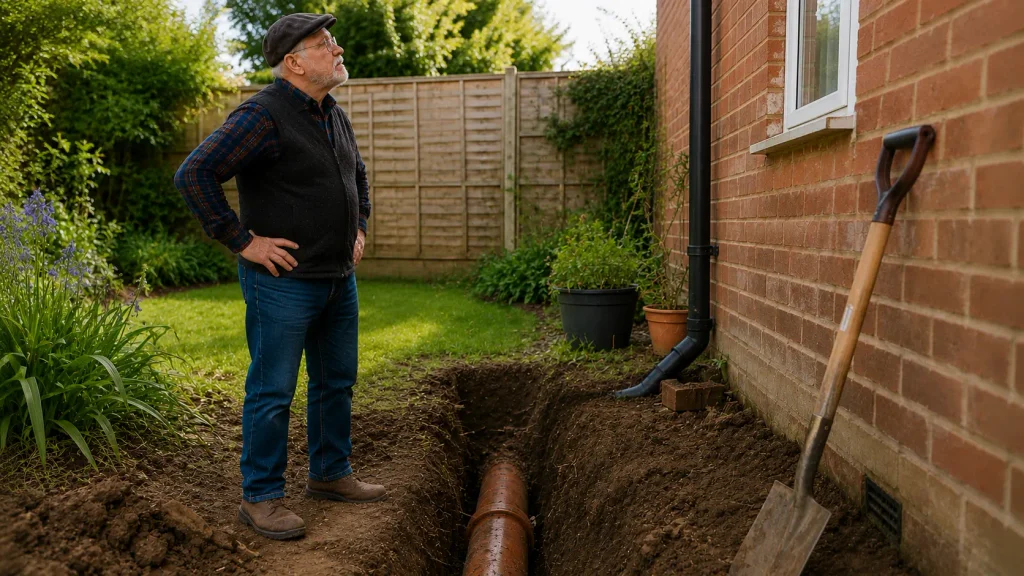
- the blockage appears to be in an underground drainage run;
- tree roots or damaged pipework may be involved;
- you cannot safely access the blockage.
At that point the problem may be in the drainage system rather than the toilet, and specialist equipment may be needed.
Preventing Toilet Blockages
Most toilet drainage systems are remarkably reliable when they’re asked to do what they were designed to do.
The simplest prevention is also the most obvious:
Only flush material intended to go through the toilet.
Toilet paper is designed to break down in water.
Wet wipes, sanitary products, paper towels, kitchen roll and other materials can behave very differently once they enter the drainage system.
Even products labelled “flushable” can cause problems in some drainage systems, particularly where the pipework or sewage system is marginal.
If your toilet repeatedly blocks despite being used normally, don’t simply keep clearing it. A recurring blockage is a symptom worth investigating.
Frequently Asked Questions
Why won’t my toilet flush but the water goes down slowly?
You probably have a partial blockage. Don’t keep flushing it in the hope that the remaining water will carry it away. Try a toilet plunger first.
What is the best tool for an ordinary blocked toilet?
A flanged toilet plunger is the best first tool for many straightforward blockages. A toilet auger is the next step if plunging doesn’t work.
Should I use a sink plunger on a toilet?
A flat sink plunger doesn’t make as good a seal in a toilet outlet. A flanged toilet plunger is designed for the job.
Can I use boiling water to unblock a toilet?
No. If you try warm water, keep it well below boiling temperature. Boiling water can damage the toilet.
What if something solid has fallen into the toilet?
Don’t keep flushing or repeatedly plunging it. If you know that a solid object has gone into the toilet, the best solution may be to retrieve it before it travels farther into the drainage system.
Why does my toilet keep blocking?
A recurring blockage may indicate an obstruction further down the drainage pipe, a poorly designed or damaged section of pipe, insufficient fall, tree-root intrusion or another drainage problem.
The Most Important Thing to Remember
A blocked toilet doesn’t always mean a blocked toilet.
The obstruction may be in the trap, immediately beyond the toilet, or much farther down the drainage system.
Start with the simple things. Don’t make the problem worse by repeatedly flushing, and don’t attack an unknown blockage with chemicals or improvised tools.
And if you can safely access the drainage system, remember the old fault-finding rule:

Don’t search the whole system at once. Divide it into sections and find which section contains the fault.
It worked for me once.
I found the blockage almost exactly where I chose to investigate.
Twenty minutes later, the toilet was working again.