
Which Styrocrete Mix Should I Use?
Table of Contents
One of the first questions people ask after making their first test batch is:
“Can I make it stronger?”
The answer is yes.
But the next question is…
“Do you actually need to?”
One of the biggest mistakes beginners make is assuming that stronger is always better.
It isn’t.
Styrocrete is all about getting the right balance between strength, weight and insulation.
Add more cement and the material becomes stronger.
Unfortunately, it also becomes heavier and loses some of its insulating properties.
The trick is using just enough cement for the job in hand.
Think About The Job First
Before you even open a bag of cement, ask yourself one question.
What am I trying to build?
A lightweight roof insulation layer doesn’t need the same styrocrete mix as a workshop floor.
A deep void under a conservatory doesn’t need the same strength as a wall panel.
Choose the styrocrete mix to suit the job—not the other way round.
The Basic Rule
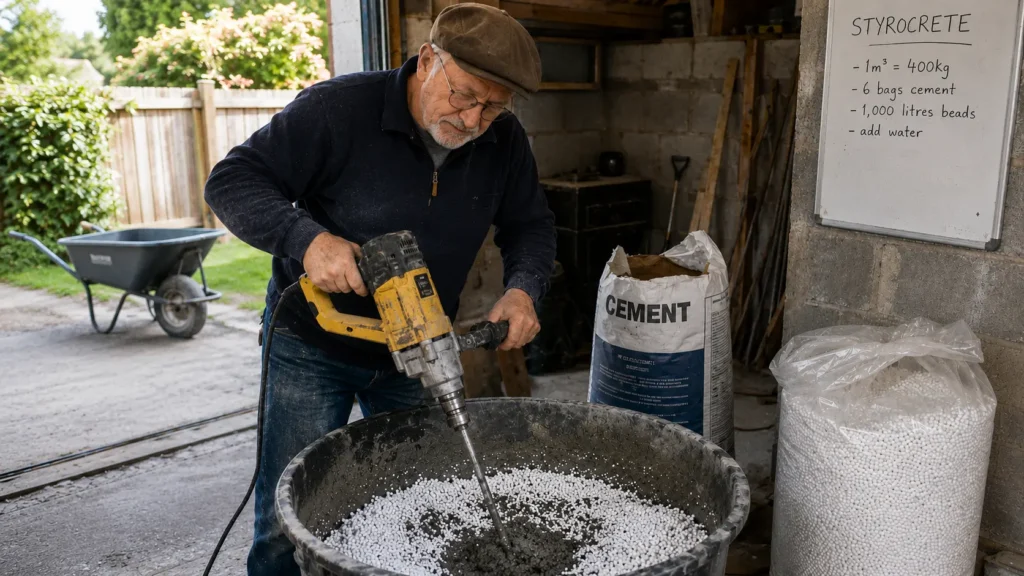
Styrocrete is usually measured by volume, not by weight.
That makes life much easier.
You don’t need scales.
If you use one bucket of cement, you simply add the required number of buckets of chopped EPS.
Simple.
Typical Mixes
10 : 1
Ten buckets of EPS.
One bucket of cement.
Use when:
- maximum insulation is more important than strength
- filling deep voids
- roof insulation
Very light.
Excellent insulation.
Not intended for loads.
8 : 1
A good all-round insulation mix.
Ideal for:
- floors beneath screeds
- conservatories
- extensions
- garage insulation
This is probably the styrocrete mixwhere many DIY builders will start.
6 : 1
A stronger mix.
Suitable where the Styrocrete may experience a little more stress before being covered.
Still lightweight.
Still a good insulator.
4 : 1
Now we’re moving towards maximum practical strength.
Useful for lightweight blocks and some wall panels.
Heavier.
Less insulation.
More cement cost.
3 : 1
About as rich as most DIY builders are likely to go.
This is not structural concrete, but it gives considerably higher strength than leaner mixes.
Only use it if you genuinely need it.
Water
Now comes the awkward bit.
Everybody asks:
“Exactly how much water?”
There isn’t an exact answer.
Different cements behave differently.
Your chopped EPS may be fine or coarse.
Even the weather makes a difference.
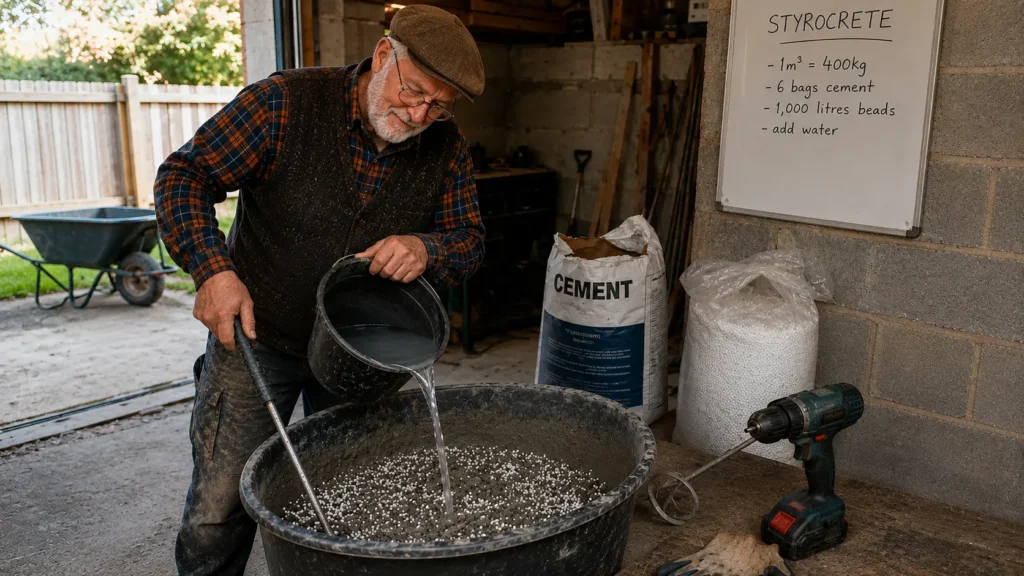
The correct amount is simply enough water to coat every piece of EPS with cement paste.
If the styrocrete mix runs like soup…
you’ve added too much.
If dry cement is falling off the beads…
you need a little more.
Always add water gradually.
You can always add a little more.
You can’t easily take it out. The only thing you can do if you added too much water, is to add more cement and beads until it thickens up again and no doubt you will now have more than you need.
Test Batch Recipes
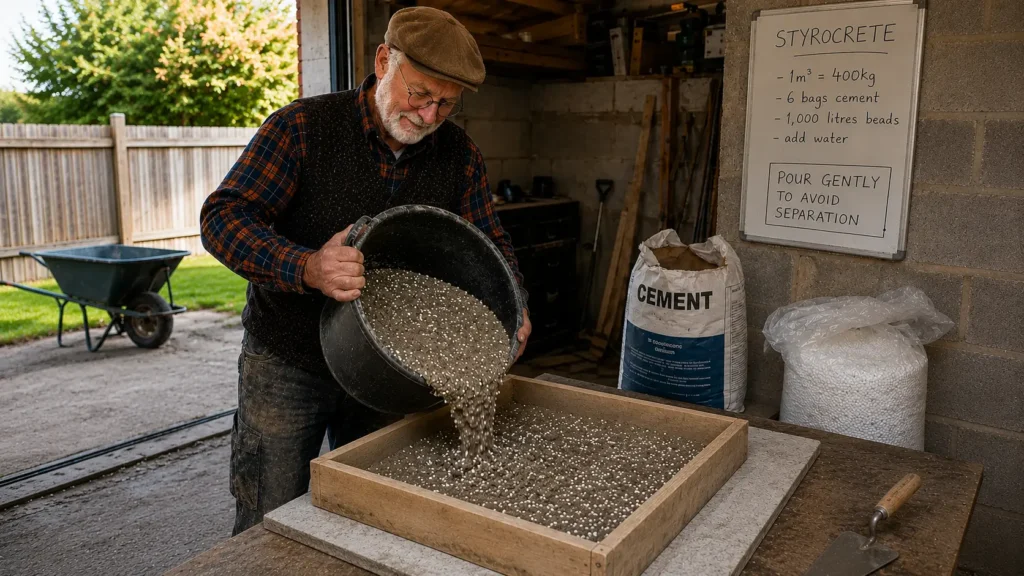
This is where I’d give people something practical.
Five-litre batch
- 5 litres EPS
- 0.5 litre cement
- Water as required
Ten-litre batch
- 10 litres EPS
- 1 litre cement
- Water as required
Twenty-litre batch
- 20 litres EPS
- 2 litres cement
- Water as required
Notice the pattern?
Once you understand the ratio, you can make any quantity you like.
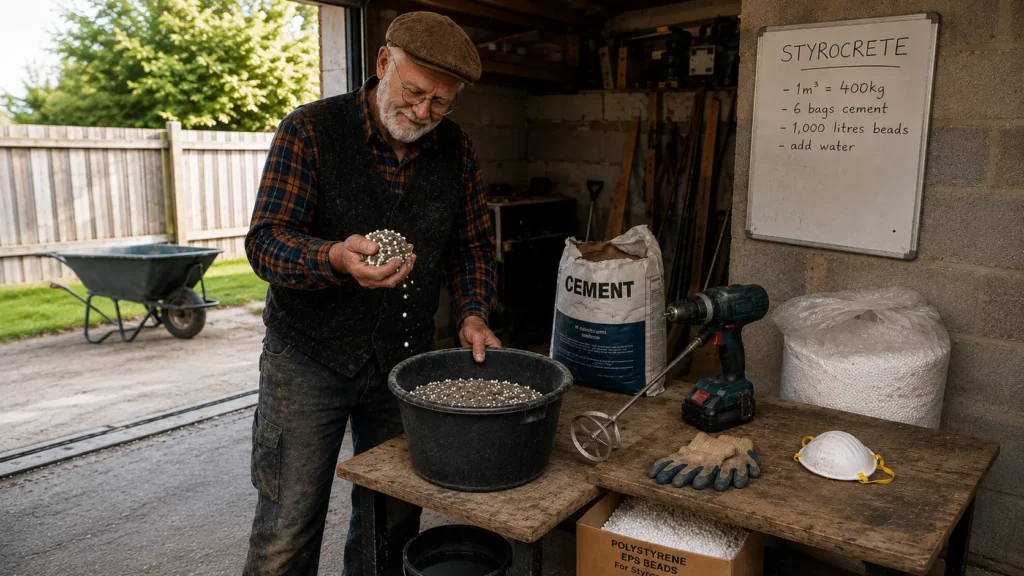
Tom’s Workshop Tip
Don’t get hung up on producing the “perfect” mix first time.
Mix ratios are a guide, not a religion.
Make a small batch.
Let it cure.
Pick it up.
Break it.
Learn from it.
That’s worth far more than copying somebody else’s numbers.
Decision Guide
I’m insulating a garage floor → Start with 8:1.
I’m filling a deep void → Try 10:1.
I’m making lightweight blocks → Consider 4:1.
I’m not sure → Make a 10-litre test batch at 8:1.