
The results to date of a necessary addition to a village house and I wholeheartedly recommend the project to anyone thinking of upgrading their toilet disposal facilities. I opened the filter tank today to check progress and was delighted to see only the layer of shavings and no other deposits.
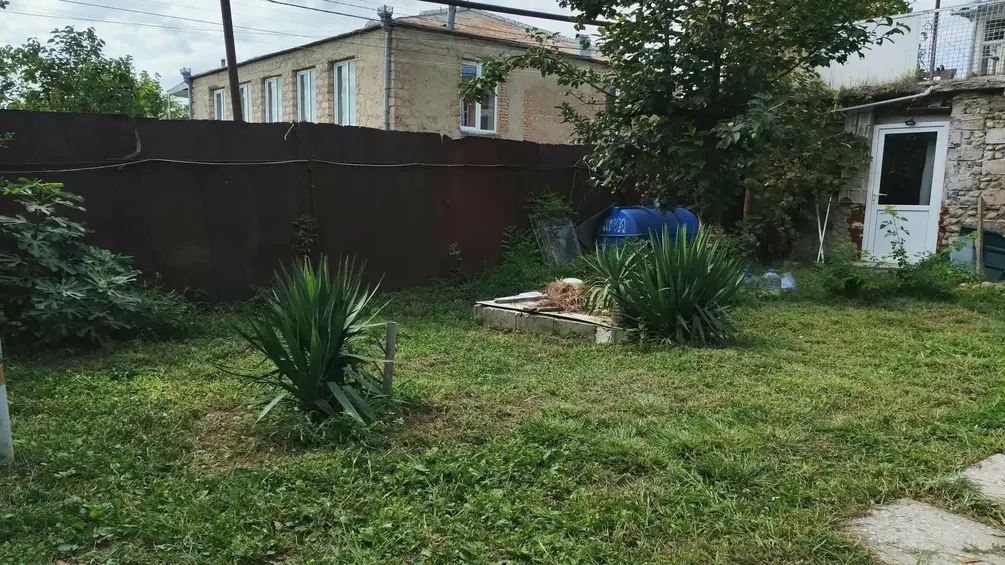
Table of Contents
A simple biological waste-disposal system built in a rural Georgian village
There are some subjects that aren’t particularly pleasant to talk about.
What happens to your toilet waste when there is no mains sewage system? is probably one of them.
But it is a problem that has to be dealt with, and it is a much bigger problem than most people in countries with modern sewer networks realise.
In 2024, according to the World Health Organization and UNICEF Joint Monitoring Programme, 47% of the world’s population was using on-site sanitation, compared with 42% using sewer connections. In other words, on-site sanitation is not some obscure solution used by a handful of people in remote villages. It is the way a very large proportion of the world’s population deals with household sanitation.
I live in a rural village in Georgia where there is no mains sewage system.
So I had to find my own answer.
And after living with the traditional solution for several years, I decided that there had to be a better one.
The old solution: dig a hole and hope
The original toilet waste system was essentially the traditional rural solution: waste went into a pit in the ground and was left to soak away naturally.
It worked for a while.
Then it didn’t.
After only a couple of years the pit was full to the brim and was no longer soaking away properly. Eventually it had to be abandoned.
I left the old pit unused for about six months. Eventually the contents dispersed sufficiently for me to fill it with garden soil.
That was enough to convince me that simply digging another hole wasn’t the answer.
I wanted something that would:
- use an ordinary flush toilet;
- require no chemicals;
- produce no unpleasant smell;
- deal with the solid waste biologically;
- require very little attention;
- and, most importantly, not eventually turn into another full pit that needed emptying.
So I started looking at biological sanitation systems.
Where the idea came from
I didn’t invent the principle.
Before building my system, I had studied information about bio-digester toilets being used in countries including Ghana and elsewhere in Africa.
Ghana has taken the technology particularly seriously. Its Ministry of Sanitation and Water Resources, through the GAMA Sanitation and Water Project, produced a detailed construction and installation manual for bio-digester toilets. The manual describes anaerobic digestion as the biological breakdown of organic material in the absence of oxygen and discusses dry fibrous materials such as sawdust, wood shavings and coconut fibre as bulking materials.
The technology became particularly widespread in the low-income communities covered by the GAMA project:the Ghanaian manual reports that approximately 98% of household toilets constructed under that particular project were bio-digesters. That figure applies to the GAMA project, not to Ghana as a whole.
I wasn’t trying to reproduce the Ghanaian installation exactly.
I was taking the principle and adapting it to my own circumstances and to the materials I could actually obtain.
And that turned out to be rather important.
Coconut fibre is fine. But try finding some in Georgia.
The Ghanaian information I had studied used fibrous material such as coconut fibre as a bulking material.
There isn’t exactly a shop in Kachreti selling bags of coconut fibre for biodigesters.
There is, however, a carpenter.
And my local carpenter had a problem of his own.
He had a considerable quantity of wood shavings and planings that he was very pleased to get rid of.
So I took a sack of them home.
Problem solved.
The important thing was not obtaining some exotic specialist material. It was finding a suitable fibrous carbon-rich material that would provide the environment needed for the biological process.
My digester toilet
The system I built has two underground sections.
The first is the digester/filter chamber.
The second is the soakaway.
The toilet uses a completely normal flush.
The waste pipe from the house enters the top of the first chamber and discharges onto a bed of wood planings.
Beneath the planings is a drainage space.
Liquid passes down through the filter material and into this space before leaving through a pipe to the second chamber.
The second chamber is the soakaway.
So, in its simplest form, the system is:
Toilet
↓
Wood-planing digester/filter
↓
Drainage space
↓
Soakaway
↓
Ground
The important point is that this is not a conventional septic tank and it isn’t a dry composting toilet.
It is a biological treatment system using a normal flush toilet.
The two chambers
I originally considered making the two sections as two separate excavations.
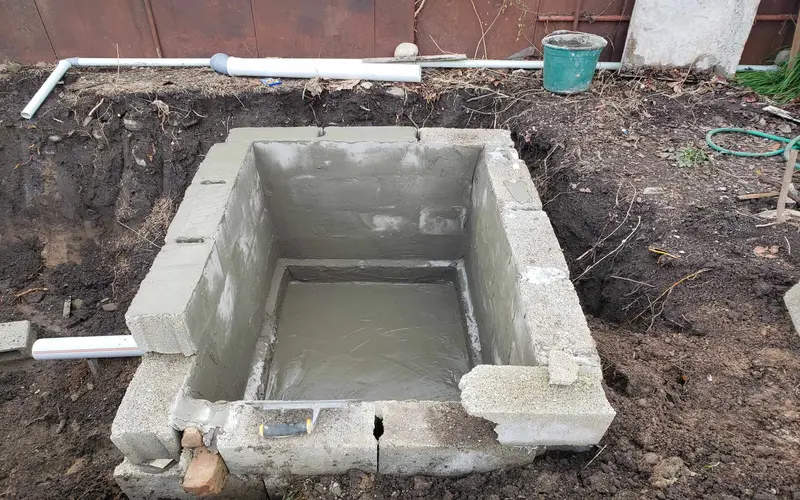
In the end I made one stepped excavation, which allowed me to construct the two sections at different levels.
The total excavation was only about 1.5 metres deep at its deepest point.
The upper section became the filter/digester.
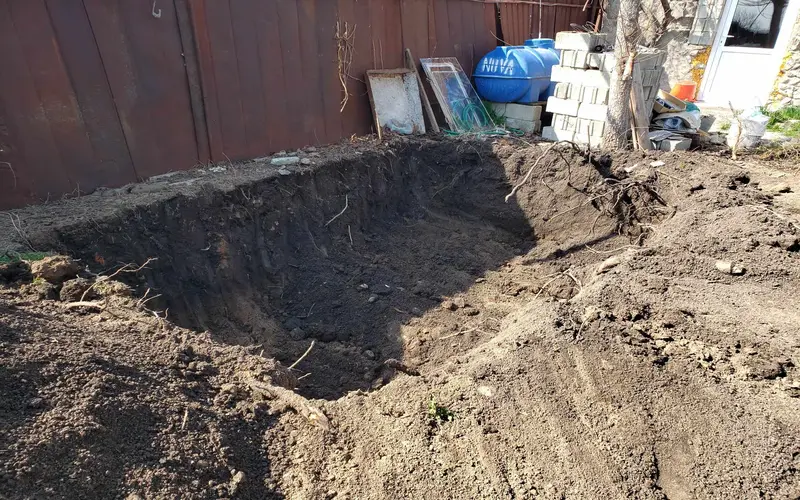
The lower section became the soakaway.
The filter chamber itself was approximately 1.75 metres long by 1.2 metres wide.
I built it from concrete blocks, skimmed the inside and gave it a solid concrete floor.
5
Making the filter
I needed to create a space beneath the filter material so that liquid could drain away.
I happened to have access to six discarded black plastic fruit crates.
They were ideal.
I turned them upside down and covered them with two layers of the green nylon fly-screen material commonly used over windows.
The crates weren’t there to support anything heavy. Their job was simply to create an open drainage space beneath the filter.
Then I filled the top of the filter with the carpenter’s wood planings.
One full sack did the job.
The nice thing about using the fruit crates was that they were free.
You could buy specialist drainage components, of course, but I was building this in a Georgian village from materials that were actually available to me.
And if you’ve ever wondered what to do with six unwanted plastic fruit crates, now you know.
Beer crates would work for the same basic purpose.
Empty them first.
I feel obliged to mention that.
Bringing the toilet into the system
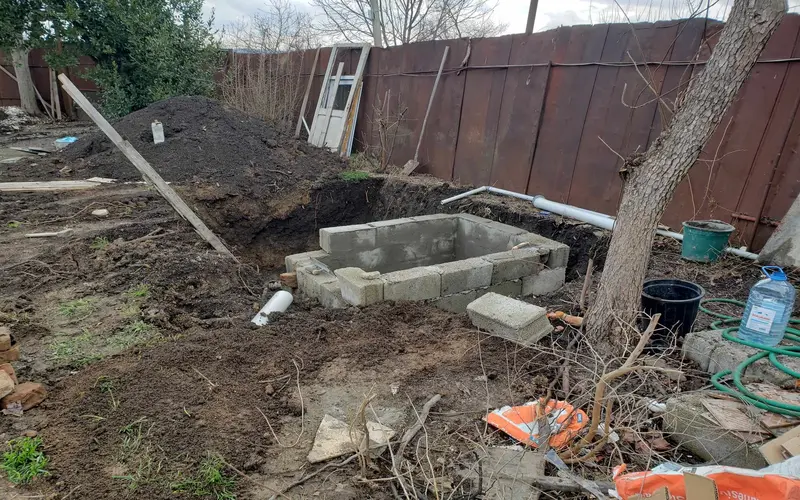
The soil pipe from the house enters the filter chamber near the top.
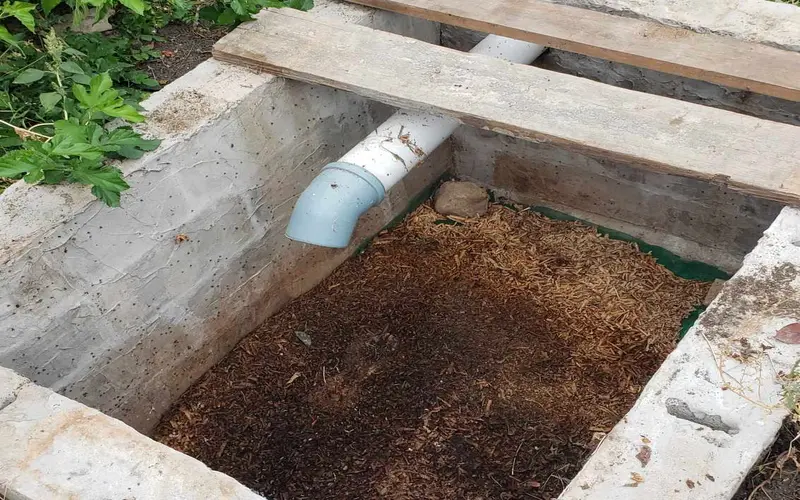
The pipe terminates above the bed of wood planings so that the waste is discharged directly onto the material.
There is no pump.
There is no complicated mechanical mechanism.
The toilet simply flushes as normal.
The biological treatment takes place underground.
The soakaway
The second chamber is lower than the filter.
It has no concrete floor.
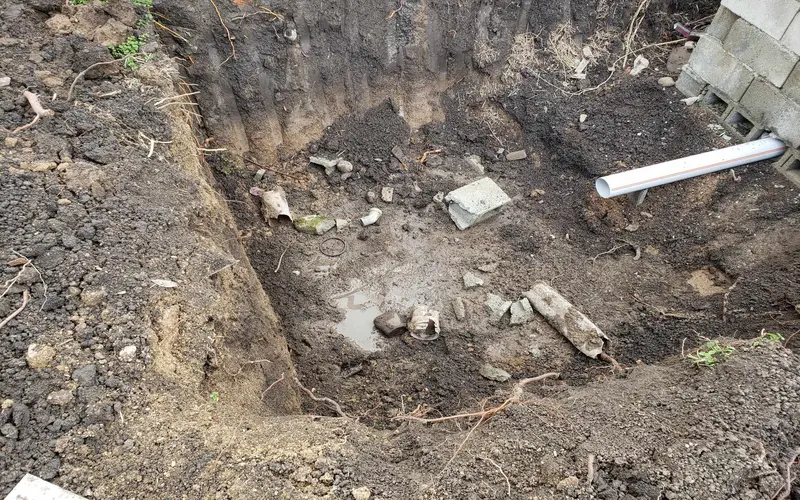
Instead, I built it from blocks with approximately 5 cm gaps between them.
Those gaps are important because they allow the liquid leaving the filter to spread out into the surrounding stone rather than being restricted to the floor area of the chamber.
I filled the space around the soakaway chamber with rocks.
The idea was to provide a large area into which the liquid could disperse before soaking into the surrounding ground.
The pipe from the filter enters near the upper part of this chamber.
The soakaway therefore acts as a receiving and distribution area rather than a sealed storage tank.
[IMAGE: Your photograph showing the soakaway under construction]
I also connected the household greywater
I had another pipe running from the kitchen sink, shower and washing machine into the soakaway section.
This was a separate pipe from the toilet waste pipe.
The arrangement meant that the household wastewater could discharge into the lower section rather than entering the biological filter itself.
This is one part of the design where local soil conditions, groundwater levels and local regulations matter considerably, so I would not suggest that somebody simply copies this arrangement without checking whether it is appropriate for their own site.
My system is a record of what I built and how it has performed. It isn’t a universal sewage-treatment specification.
Covering everything
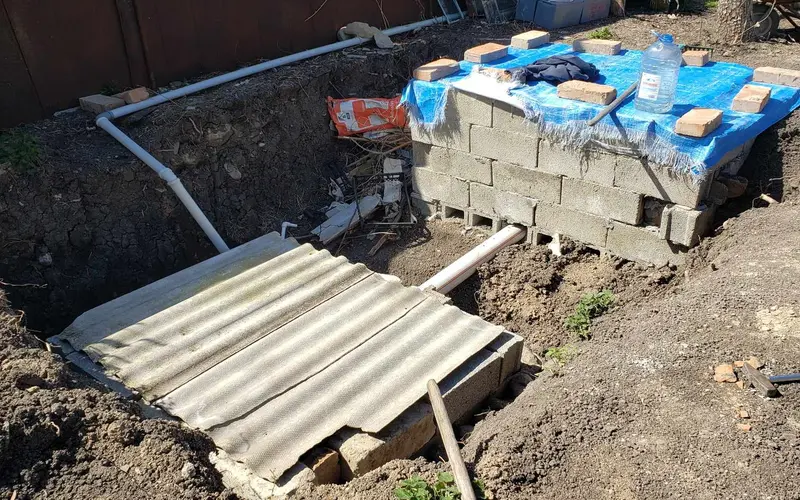
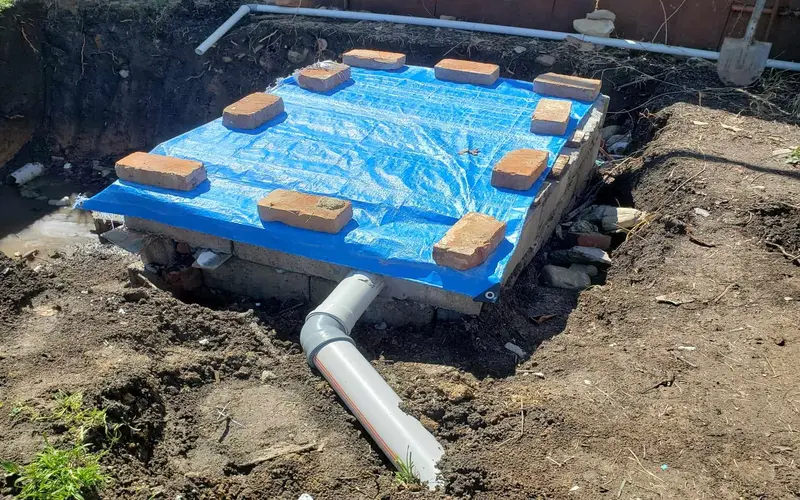
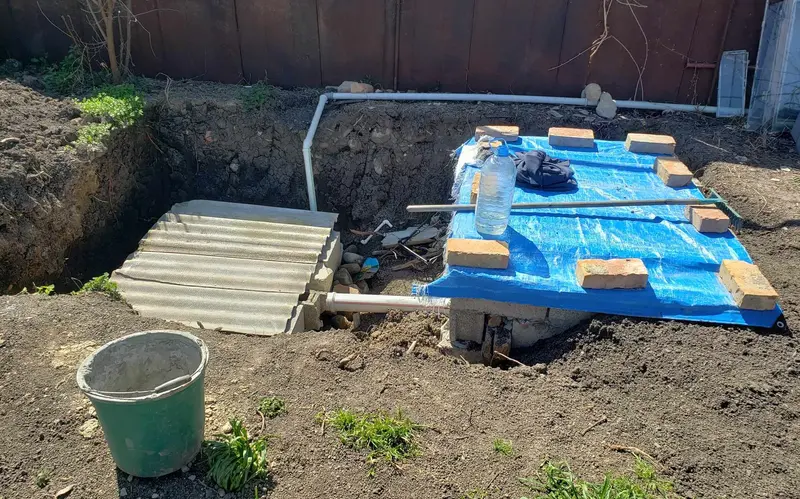
Once the construction was complete, I covered the soakaway with several layers of discarded corrugated roofing sheets.
The intention was that the whole thing would eventually disappear beneath the garden.
I covered the structure with plastic sheeting and returned the excavated soil until everything was back at approximately garden level.
The filter chamber was left slightly proud of the ground so that I could inspect it.
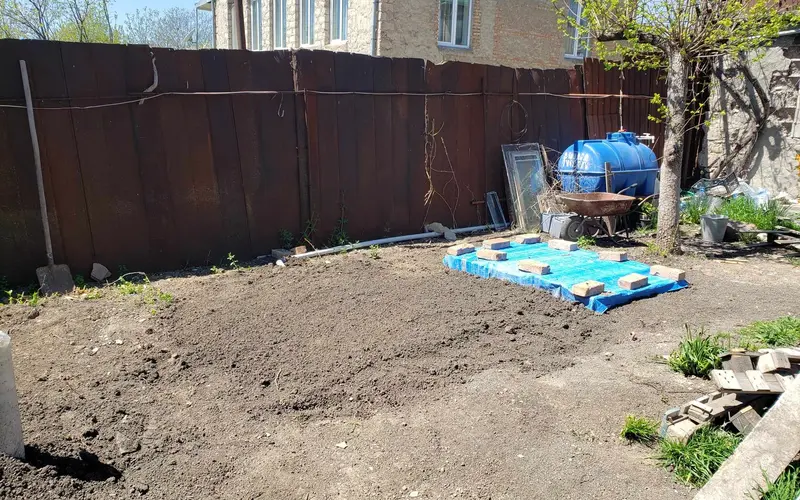
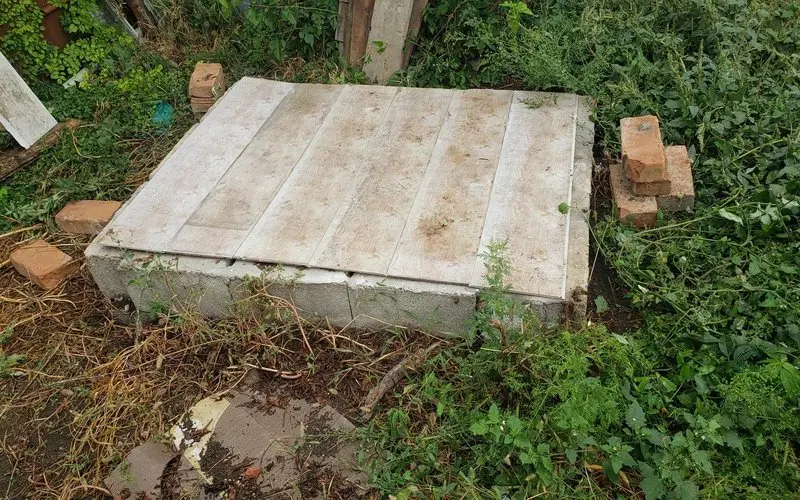
That is what the installation looked like just before I finally covered it.
Once the job was finished, there was very little to see.
Just a garden.
Then I did something most people probably wouldn’t do
After about a year of use, I decided I wanted to know exactly what was happening inside.
So I opened the filter chamber.
I wasn’t expecting to find a pristine installation.
I was expecting something.
What I found was surprisingly little.
There was no unpleasant smell.
There was no accumulation of solid waste.
There was no obvious sign of the filter becoming blocked.
What remained was the layer of wood shavings/planings, which had turned grey.
That was it.
I closed it up again.
And carried on using it.
[IMAGE: Your photograph of the filter after opening it for inspection]
That inspection was probably the point at which I stopped thinking of the system as an experiment and started thinking of it as my toilet system.
Several years on
The system has now been in operation for several years.
It has not needed the sort of routine intervention that the old pit eventually required.
There are no chemicals to add.
There is no noticeable smell.
There is no regular emptying of a conventional tank.
And there is no mechanical equipment to maintain.
The most significant thing for me, however, is that I have actually been able to inspect it rather than simply assuming it works.
That matters.
It is very easy to build something, bury it and declare it a success.
It is much more convincing to open it a year later and see what has actually happened.
Why I prefer it to the old pit
The old system depended essentially upon storing waste in the ground and hoping that enough liquid would disappear into the surrounding soil.
Eventually it didn’t.
The new system is fundamentally different.
The waste enters a biological treatment environment containing the wood-planing filter material. Liquid is separated from the bulk material and directed to a separate dispersal area.
There is no large underground reservoir intended simply to fill up with sewage.
That is the fundamental reason I built it.
What I like about the system
After several years of living with it, these are the things that matter to me:
No smell
Even when I opened the filter chamber for inspection, there was no unpleasant sewage smell.
No chemicals
I don’t have to add proprietary chemicals or treatments.
Normal flushing
There is no special toilet procedure for the people using it.
Very little attention
In my experience, it simply gets on with its job.
No conventional tank to empty
The old pit eventually became a storage problem.
That has not happened with this system during my years of use.
It disappears into the garden
Once the construction is complete, there is very little to see.
And perhaps most importantly:
It was made from ordinary materials
Concrete blocks.
Cement.
Plastic fruit crates.
Fly screen.
Wood planings from a local carpenter.
Pipe.
Stone.
Nothing particularly exotic.
Would I build it again?
Yes.
In fact, I am sufficiently pleased with it that the design has been copied by other people locally after I described it in a Facebook group.
That is probably the best compliment the system has received.
People don’t normally copy things that don’t work.
But I should make one thing clear.
This article is an account of my own system, not a guarantee that an identical installation will work everywhere.
Ground conditions, groundwater, soil permeability, rainfall, climate, construction quality and local regulations all matter when dealing with household wastewater.
A soakaway that works perfectly in one location may be completely unsuitable in another.
Anyone considering an on-site sanitation system should check the requirements that apply where they live and make sure that the final discharge is environmentally and legally acceptable.
The final result
The photograph below is probably my favourite one of the whole project.
It doesn’t look like a sewage-treatment system.
It doesn’t look like a toilet project.
It doesn’t even look particularly interesting.
It’s just a garden.
And underneath it is the system I built because I was fed up with digging holes and eventually having to empty them.
4
And that’s probably the best thing I can say about it.
It works away underground, and I don’t have to think about it.
A note about the design
The system described here is my own adaptation of the biodigester principle, influenced by published sanitation work from Ghana and other countries. The Ghanaian government manual describes bio-digesters, bulking materials including sawdust/wood shavings and methods of effluent management; it also stresses proper siting, construction, monitoring and maintenance.
The WHO/UNICEF sanitation framework similarly recognises that on-site sanitation can be safely managed when excreta are appropriately contained and safely treated or disposed of in situ. Simply being “on-site”, however, does not by itself make a sanitation system safe.