
A Woodworking Router for the DIY Enthusiast
So, you’ve tackled the world of DIY with a trusty hammer, some nails, and maybe even a jigsaw or two. But now, you’re ready for the next big step – the woodworking router. Yes, my friend, the router. It’s the tool that transforms your woodworking projects from “just okay” to “WOW, did you really make that?” It’s like the difference between a regular cup of coffee and a triple-shot caramel macchiato – one is nice, but the other will have you buzzing with excitement.
Table of Contents
But what exactly is a router, and why do you need one? Let’s dive into the wonderful world of routers, accessories, and all the reasons why this tool should be a staple in every DIY enthusiast’s toolbox.
What Is a Router?

First things first – a router is a handheld or table-mounted power toolused to hollow out (or “rout”) an area in wood. It’s most commonly used to create decorative edges, joinery, grooves, and patterns. Think of it as the fine sculptor of your DIY projects. It allows you to add intricate details and smooth edges, and make your work look more polished than the guy next door with just a hammer and a prayer.
Routers come in two main types: fixed base and plunge base.
- Fixed-base routers are great for beginners. The depth of the cut is set before you start, and it stays locked in place. This is ideal for simple tasks like trimming edges or creating grooves.
- Plunge-base routers give you the ability to start cutting from the middle of a board, which makes them more versatile. You can “plunge” the bit into the wood and lift it back out at will. It’s like the difference between ice skating in a straight line and doing figure eights – more complex, but oh-so-satisfying once you get the hang of it.
Some routers combine both features, giving you a two-in-one option for the best of both worlds. In fact most routers are built like this now which is only a matter of setting the plunge router to the depth you want and mechanically locking it there.
I have had two routers by different manufacturers and this facility has been on both. My present router has turned out to be very good value for money – a Crown CT11012
Why You Need a Router
If you’re serious about woodworking, a router is one of the most versatile tools you can own. Here’s why it’s worth the investment:
- Edgework that Impresses: Want to add a decorative edge to that DIY bookshelf you’ve been working on? A router can give your project professional-looking, detailed edges that make your work stand out. Beading, rounding over, chamfering – you name it, the router can do it.
- Grooves and Slots: If you need to cut a groove or a slot into your wood for joints or inserts, the router is your best friend. It’s like creating a hidden little pocket in your woodwork – practical and stylish.
- Inlay Work: You know those intricate designs you see in high-end furniture? Many of them were made using a router. Whether you want to create custom patterns or add decorative inlays, a router can make it happen.
- Joinery: Mortises, tenons, and dovetail joints are easy to create with a router. This is where the plunge feature comes in handy – it allows you to cut perfect mortises in no time. A router helps you make strong, professional-quality joints without breaking a sweat (well, maybe just a little sweat).
What to Look for When Buying a Router
Before you rush off to the nearest hardware store to buy the first router you see, there are a few things you should consider. Think of this as the “speed dating” part of your DIY journey – you want to find the perfect match for your needs.
1. Power
Router motors are measured in horsepower (HP), and more horsepower means more cutting power. A motor with 1.5 to 2.25 HP is usually enough for most DIY projects, but if you plan on tackling bigger, tougher materials, go for something in the 3 HP range. Remember, this isn’t a delicate tea party – you need some serious oomph to carve through hardwood.
2. Speed Control
Look for a router with variable speed control. Different woods and different tasks require different speeds, so being able to adjust your router’s speed is a big bonus. As a general rule, slower speeds work better for larger bits, while faster speeds are ideal for smaller bits. It’s like driving a car – you wouldn’t speed through a school zone, right?
3. Ergonomics
You’ll be holding this bad boy for long stretches, so make sure it feels comfortable in your hands. Look for one with a good grip, well-balanced weight, and easily accessible controls. Trust me, your wrists will thank you later.
4. Collet Size
The collet is the part of the router that holds the bit in place. Most routers come with either a 1/4-inch or 1/2-inch collet. A 1/2-inch collet is more stable and holds larger bits, but it’s good to have both sizes for versatility. It’s like having both sneakers and dress shoes – you’ll need each one for different occasions.
I have both 1/2 inch and 1/4 inch router bits which I bought at different times. I had wanted all one size but I couldn’t find all 1/2 inch. In practice, I have not found any difference in using them as the collet seems to be adequate to make up for the size difference.
5. Dust Collection
Routing can be messy, and I’m not just talking about the wood chips flying around. Look for a router that has a dust collection feature or an attachment for your shop vacuum. This will help keep your workspace cleaner and save you from sweeping up a small mountain of sawdust afterwards. Again, although I am saying this, all of my cutting is done outside so I’ve not actually found this to be of any consequence. It’s all up to the individual’s circumstances.
Router Bits: The Unsung Heroes
A router is nothing without its bits, much like a guitar is useless without strings. The router bits are what actually make contact with the wood and create all the magic. You’ll want to invest in a few different types of bits to get the most out of your router. Here are some of the most common ones:
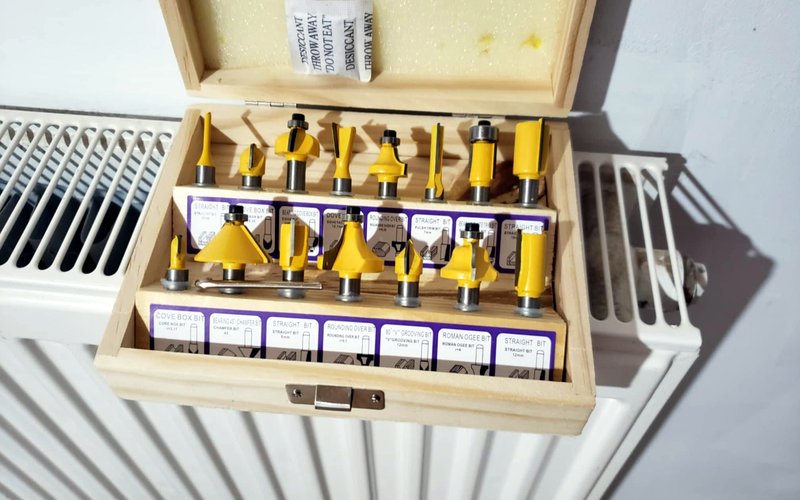
- Straight Bits: Used for cutting straight, clean grooves and dados.
- Rabbeting Bits: These create a notch along the edge of the wood, perfect for joinery.
- Roundover Bits: These bits round off sharp edges, giving them a smooth, finished look.
- Chamfer Bits: If you want to cut an angled edge, a chamfer bit will do the trick.
- Flush Trim Bits: These are perfect for trimming the edge of one material to match the shape of another, such as when applying a veneer.
Remember, bits come in different sizes and shapes, so don’t be afraid to experiment. Just be sure to use the right bit for the job – using a small bit for heavy-duty work is like trying to slice a loaf of bread with a butter knife.
Must-Have Router Accessories
Now that you’ve picked out your router and some essential bits, let’s talk about the extras that’ll make your router life even better. Accessories aren’t just for showing off (though that’s a bonus); they’re about maximizing the potential of your new favourite tool.
1. Router Table
A router table is like turning your handheld router into a powerhouse. With the router mounted underneath, the table gives you better control for precision work, such as joinery and edge trimming. It’s also much safer when handling small pieces of wood. Think of the router table as a hands-free mode for your router.
Once the router is mounted on the table, your hands are free to simply push the wood across the surface of the table in contact with the router.
CAUTION:When you are using this means of routing be careful. Remember that the bit is revolving at around 30,000 times a minute. It takes very little contact to remove the end of your finger. Keep counting them one to ten. I can only count from one to 9 and 7/8……
2. Edge Guide
An edge guide is a simple but invaluable accessory. It attaches to your router and runs along the edge of your wood to help you cut straight clean lines. If your goal is to avoid freehand wobbliness (which can turn a project from hero to zero real quick), the edge guide is a must and always comes with a decent router in any case.
3. Template Guides
Template guides allow you to follow a pattern for more intricate work. Whether you’re doing inlay work, cutting signs, or repeating shapes, these guides help you stay on track like a woodworking GPS.
A stationary sleeve around the cutter runs inside your template, guiding the cutter precisely.
4. Router Lift
This handy accessory allows you to adjust the height of the router bit without having to reach under the table or unscrew anything. It’s a luxury item, but if you do a lot of precision work, it’s worth every penny. Plus, you’ll feel like a pro with one.
Using Your Router: Tips and Tricks
Now that you’ve got your router and all the accessories, it’s time to get to work. Here are some tips and tricks to help you get the most out of your router and avoid any DIY disasters.
- Practice Makes Perfect: Before you start routing on your actual project, take some scrap wood and practice. This will help you get a feel for the tool and avoid any costly mistakes. It’s like warming up before a workout – you’ll perform better in the long run.
- Go with the Grain: When routing, always try to work with the grain of the wood rather than against it. Going against the grain can cause tear-out, which isn’t pretty and will require extra sanding. And who wants to do more sanding than necessary?
- Multiple Passes: Don’t try to remove too much material in one pass. It’s tempting, but you’ll end up with a rough, uneven cut. Instead, make several shallow passes until you reach the desired depth. It’s like peeling an onion – one layer at a time, and fewer tears. I usually find that two runs are enough.
- Clamp It Down: Always clamp your workpiece securelyto the bench or table. Routing is a two-handed operation, and you don’t want the wood moving around while you’re working. That’s a recipe for disaster – and possibly flying wood chunks.
Get Ready to Route
With a router in your toolkit, you’re no longer just building—you’re adding character, flair, and finesse to your projects. This tool’s versatility unlocks endless possibilities, from creating elegant edges to crafting detailed inlays. With the right bits, accessories, and a bit of practice, you’ll soon be routing like a pro, transforming plain wood into polished pieces that look straight out of a custom workshop. So, get ready to route, shape, and explore the creative side of woodworking—because with a router, the only limit is your imagination!